



This website uses cookies to improve your experience and analyze website traffic. By continuing to browse, you consent to our use of cookies. See our privacy policy for more information.
September 8, 2026
On August 11, 2026, the Department of the Treasury and Internal Revenue Service issued proposed regulations addressing nondiscrimination rules for Dependent Care Assistance Programs (DCAPs), as well as related rules for employer contributions to Trump Accounts. For DCAP sponsors, the most significant development is proposed clarification of the §129 nondiscrimination tests, including a more workable approach to the 55% average benefits test. Although the regulations are only proposed, the preamble permits taxpayers to rely on the proposed regulations until final regulations are published.
For DCAP sponsors, the proposal is significant because there were not previously implementing regulations for how Code §129 requirements should operate. The proposal confirms the four existing tests and, in several respects, formalizes testing approaches already used in practice. It also provides useful new clarification regarding the eligibility test and the 55% average benefits test and the consequences of a testing failure.
DCAP Nondiscrimination Framework
§129 rules allow DCAPs to provide up to $7,500 each calendar year in tax-favored qualifying daycare assistance, but §129 rules also prohibit DCAPs from favoring highly compensated employees (HCEs) on a tax-favored basis. A difference in eligibility rules, waiting periods, employer contributions or benefit coverage can all potentially cause issues under §129 nondiscrimination rules if the more generous offering or coverage favors HCEs.
For this purpose, HCEs include >5% owners and employees whose compensation exceeds a certain threshold (e.g., for 2026, employees who received $160,000 or more in 2025). To determine compliance, §129 requires a DCAP to satisfy four nondiscrimination tests. A DCAP must pass all four tests; if any of the four tests are failed and timely corrections are not made, all DCAP benefits elected by HCEs must be included in their taxable income.
Four Nondiscrimination Tests
The four §129 nondiscrimination tests are outlined below. The proposed regulations clarify how several of them should be applied, particularly the eligibility and 55% average benefits tests.
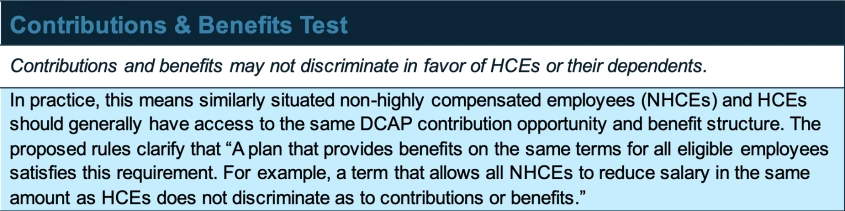
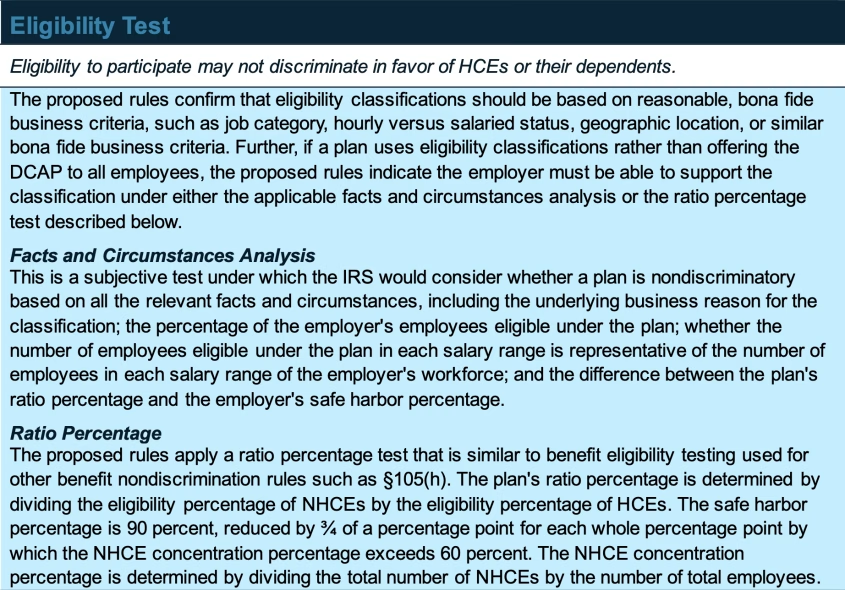

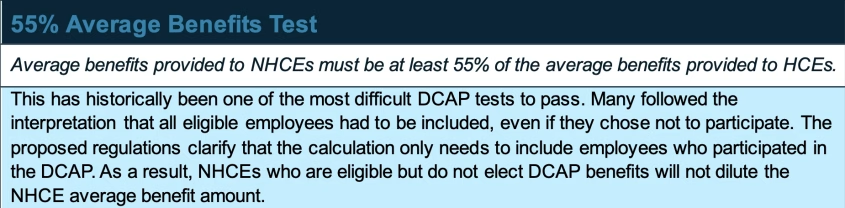
*For nondiscrimination testing, an employee or owner who was eligible or participated at any time during the year but terminated employment prior to year-end should generally be included in the testing. For purposes of the eligibility test and the average benefits test, the testing may exclude employees who are under age 21, employees who have <1 year of service, and employees who were not included in the DCAP and were covered by a collective bargaining agreement under which dependent care benefits were the subject of good faith bargaining.
Testing Failures
The proposed rules clarify that a testing failure does not disqualify all DCAP benefits. Instead, the correction generally focuses on the discriminatory portion of benefits provided to HCEs. HCEs must include the applicable taxable amount in income, and the employer should reflect that amount through appropriate Form W-2 reporting by the otherwise applicable deadline.
To avoid having to include all DCAP benefits in an HCE’s taxable income for a plan that otherwise fails any of the §129 discrimination tests, the employer can include only the discriminatory/excess benefit so long as it is done on the HCEs’ Form W-2 no later than January 31st following the end of the applicable plan year. This clarification is significant because prior guidance did not clearly provide this correction mechanism, and many practitioners interpreted the rules as requiring correction before the end of the plan year.
Summary
Employers sponsoring DCAPs should consider whether the proposed rules create an opportunity to revisit plan design, participation strategy, and testing assumptions for the current or next plan year. In particular, employers that previously limited DCAP availability because of 55% average benefits testing concerns may have more flexibility if they can rely on the participant-only averaging approach.
Employers should also coordinate with their third-party administrators and payroll teams to confirm how testing will be performed, how excludable employees will be identified, and how any HCE income inclusion will be reported if a test fails. Because the preamble permits reliance on the proposed regulations before they are finalized, employers may begin applying the clarified testing rules now.
Protect Your Organization From Costly Compliance Penalties With a Dedicated Benefits Partner
Get In TouchLooking for a partner to audit your current practices and build a sustainable employee benefits compliance program? Apex Benefits helps Indiana’s HR leaders stay ahead of federal and state requirements while keeping plans competitive and cost-effective. Reach out to get started.
Related Articles
-
February 9, 2026
Required Reporting of Creditable Status to CMS
In addition to the disclosure requirements to eligible individuals, plan sponsors of prescription drug plans are also required to report to CMS annually, within 60 days after the beginning of the plan year.
-
February 9, 2026
ACA Employer Reporting Guide
This guide contains instructions, examples, and practical hints employers can use to comply with the Affordable Care Act (ACA) employer reporting requirements and is designed to assist employer plan sponsors in understanding those requirements.
-
January 2, 2026
IRS Provides Guidance on the OBBBA’s Expansion of HSAs
On Dec. 9, 2025, the IRS issued Notice 2026-5, providing guidance on the expanded availability of health savings accounts (HSAs) under the One Big Beautiful Bill Act (OBBBA), which was signed into law by President Donald Trump on July 4, …